Description
The Photoionization Detector (PID) is one of the most widely used gas detection technologies. PIDs are extensively applied in portable instruments to detect various organic compounds and
certain inorganic gases in ambient air.
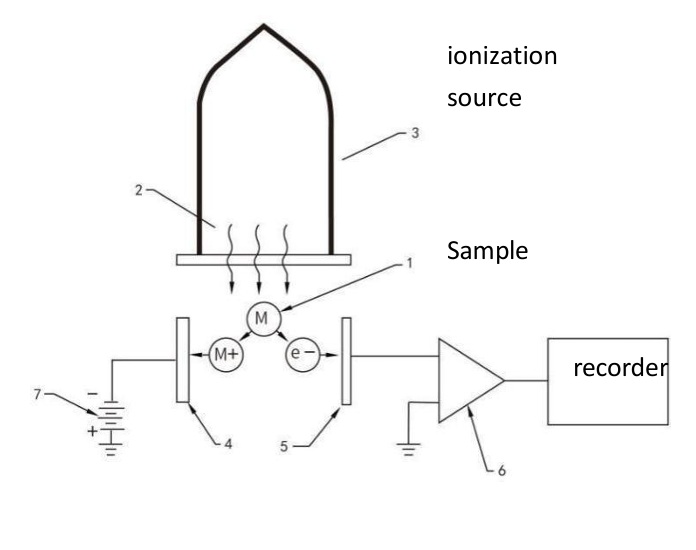
A typical PID block diagram is shown in the image right. Easily ionizable molecules (1) are exposed to high-energy vacuum ultraviolet (VUV) radiation (2) produced by a gas discharge lamp (3), where
some of them are ionized, that is, they are converted into positively charged ions and negatively charged electrons according to the following formula: M+ photon-> M+ + e-. For a molecule to be ionized, its ionization potential (IP) must be less than the energy (E) of the ultraviolet photons. Generally, the greater the difference between E and IP, the stronger the response of the PID sensor. Both E and IP are measured in electron volts (eV). Typical PID lamps emit photons with energies ranging from 8.3 to 11.7 eV. The BIKAI PID Sensor is equipped with a 10.6 eV photoionization lamp. An electrode pair (4, 5) is located in the ionization zone near the lamp window. The polarizing electrode (4) is connected to a high-voltage DC power supply (7), while the signal electrode (5) is connected to the input of an amplifier (6). The electric field generated by these electrodes drives electrons and ions to drift toward their respective electrodes, producing a small current. This current is amplified by the chip, and the resulting analog signal is recorded and/or displayed in digital or analog format. The output signal is proportional to the concentration of ionizable molecules in the PID sensor chamber, serving as a measure of concentration. Major air components (N2, O2, and CO2) have ionization potentials higher than those of the UV lamp and thus remain undetectable. As a result, PIDs are highly effective for detecting volatile organic compounds (VOCs) in ambient air without interference from air constituents, even at low ppb concentrations. Gas samples are typically delivered to the detector chamber via a pump or diffusion process.
Features
- Target gases: Volatile Organic Compounds (VOCs) and other gases with ionization potential (IP) <10.6 eV
- Lampenergy: 10.6 eV
- T90 Response Time < 3 seconds (diffusion mode)
- Temperature Range:-20℃ ~ 60℃
- Output variation with temperature: + 5%
- Relative humidity range: 0 ~ 90% (non-condensing)
- Humidity response: <1% full scale @ 90% R.H.
- Humidity quenching effect: <15% @ 90% R.H.
- Onboard Filter: Removes liquid and particles
- Power Supply Voltage: 3.2V~ 5.5V
- Current: 24 mA ~ 36 mA
- Maximumlinear output signal: 2.5V (maximum output 2.9V)
|
Measurement Range | Minimum Detection Limit | |
| PID-10000 | 0-10000 ppm | 1000 ppb | |
| PID-06000 | 0-6000 ppm | 500 ppb | |
| PID-02000 | 0-2000 ppm | 200 ppb | |
| PID-01000 | 0-1000 ppm | 100 ppb | |
| PID-00200 | 0-0200 ppm | 20 ppb | |
| PID-00100 | 0-0100 ppm | 10 ppb | |
| PID-00060 | 0-60 ppm | 5 ppb | |
| PID-00020 | 0-20 ppm | 2 ppb | |
| PID-00010 | 0-10 ppm | 1 ppb | |
| PID-00002 | 0-2 ppm | 0.5 ppb |